
The modern enterprise security stack is suffering from acute architectural fatigue. For the past decade, enterprise security strategy prioritized the acquisition of best-of-breed point solutions. This strategy left organizations with an unmanageable topology of disconnected tools, including endpoint detection, cloud security posture management, and identity threat detection.
The standard approach to resolving this fragmentation has been monolithic consolidation. Security teams tried to force all raw telemetry into a centralized data lake. However, this strategy introduces major ingestion bottlenecks, high storage bills, and severe operational latency.
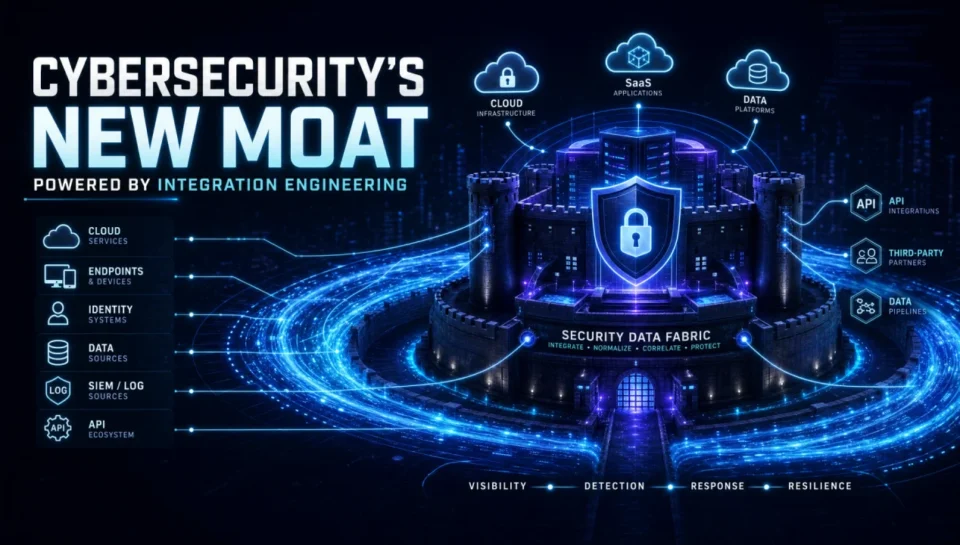
True security defensibility does not come from acquiring another detection engine or expanding a legacy data lake. It comes from implementing a Security Data Fabric built on top of elite Integration Engineering. For principal engineers, enterprise architects, and CISOs, mastering this shift is critical to building a scalable, resilient security operations center.
1. The Ingestion Crisis: Why Centralized Hot Storage Fails
The legacy approach to Security Information and Event Management (SIEM) design relies on a coupled compute and storage model. Security teams are told to extract, transform, and load (ETL) every single raw log line into a central repository to facilitate analysis.
From an engineering perspective, this model fails at scale for three primary reasons.
Compute and Storage Coupling
Legacy platforms require data to be indexed and stored in expensive hot tiers before it can be queried. When an enterprise experiences a telemetry spike during a distributed denial of service attack or a massive cloud migration, storage costs scale lineally with volume, even if 99 percent of those logs contain low-value data.
Heavy ETL Pipelines and Parsing Latency
Raw security data arrives in wildly inconsistent formats. Transforming unstructured JSON payloads from hundreds of different vendors into a queryable format requires massive compute resources. By the time data passes through ingestion queues, normalization steps, and indexing engines, minutes or hours have passed. This latency completely negates real-time threat detection capabilities.
API Rate-Limiting and Backpressure
Constantly pulling logs from cloud service providers and SaaS platforms causes severe strain on external APIs. Without robust backpressure management, ingestion pipelines drop packets or trigger vendor-enforced rate limits, creating dangerous visibility blind spots during active incidents.
A Security Data Fabric completely alters this dynamic by decoupling storage from compute, prioritizing data federation over physical replication.
2. Architectural Blueprint of a Security Data Fabric
A Security Data Fabric is a virtualized, metadata-driven abstraction layer that unifies data access across a distributed infrastructure. Instead of moving raw logs to a central repository, the fabric leaves data at the source and queries it using a federated engine.
The system architecture relies on three foundational technical pillars.
Zero-Copy Federated Query Engines
The fabric utilizes high-performance distributed SQL query engines to execute searches across disparate data stores simultaneously. When an analyst runs a query, the fabric pushes the computational logic down to the native storage layers, such as AWS S3, Google Cloud Storage, or endpoint caches, returning an aggregated result without cloning the underlying data.
Abstract Syntax Tree (AST) Translation and OCSF Normalization
To bridge the gap between different vendor syntaxes, the fabric maps all incoming telemetry to a standard schema, specifically the Open Cybersecurity Schema Framework (OCSF). The fabric achieves this by translating queries into an intermediate representation, converting the global query into vendor-specific API structures in real time.
Smart Ingestion and Telemetry Edge Routing
Instead of acting as a passive recipient of logs, the fabric functions as an active traffic controller. It evaluates data at the edge, applying programmable filters to discard repetitive network noise while routing high-fidelity, enriched context to hot analytics tiers.
Architectural Performance Comparison
← Scroll to view →
| Evaluation Metric | Centralized Lakehouse Architecture | Federated Security Data Fabric |
|---|---|---|
| Data Locality | Physics-based replication to single silo | Logical virtualization across native sources |
| Schema Application | Schema-on-write (Heavy upfront compute) | Schema-on-read (Dynamic translation) |
| Storage Overhead | Double or triple storage costs | Zero-copy infrastructure utilization |
| Query Mechanism | Localized indexing tables | Distributed push-down query compilation |
3. The Technical Reality of Integration Engineering
Many generalist observers view integrations as trivial software connectors. In the enterprise security domain, shallow API hooks are insufficient. True Integration Engineering is a complex software discipline focused on building resilient, state-aware, bidirectional data pipelines.
The engineering complexity of this layer creates a powerful technical moat for platforms that master it.
Resolving Schema Drift Independently
Third-party security vendors constantly modify their software, introducing subtle payload updates without warning. A change in a JSON key name can break traditional parsing rules, leading to silent data degradation. Advanced integration engineering utilizes automated schema discovery and defensive parsing models to intercept schema drift, preserving pipeline stability without requiring manual code changes.
Idempotency and State Management in Bidirectional Workflows
Modern security operations demand bidirectional automation. If the fabric detects a credential theft event, it must instruct an identity provider to revoke the user session and simultaneously command an EDR platform to isolate the host. Managing this distributed state across asynchronous APIs requires rigorous engineering. Pipelines must implement idempotent retries, distributed locking mechanisms, and robust error-handling states to prevent race conditions during containment operations.
High-Throughput Stream Optimization
Handling real-time security events across a global enterprise requires processing hundreds of thousands of events per second. Integration engineers must write highly optimized network code, leveraging low-level memory management and efficient serialization formats like Protocol Buffers or Apache Avro to minimize execution latency.
Once an enterprise weaves a platform’s integration layer into fifty internal operational tools, the switching costs become prohibitive. Replacing that platform introduces significant operational risk and requires re-architecting your entire enterprise workflow topology.
4. The Architect’s Blueprint: Selecting a Resilient Platform
When designing or acquiring a modern data architecture, enterprise security architects must focus on infrastructural defensibility rather than high-level feature sets.
- Avoid Proprietary Lock-In: Avoid systems that require proprietary log forwarding agents or lock your organization into specialized, non-standard storage formats. Platforms that do not support open data formats like Apache Parquet or Iceberg increase future engineering debt.
- Mandate OCSF Compliance at the Abstraction Layer: Ensure that the integration platform natively maps data to open taxonomies like OCSF before executing analytics. If a vendor relies on custom internal translation tables, you will face significant engineering overhead when adding new tools to your ecosystem.
- Verify True Push-Down Query Capabilities: Test the platform’s ability to execute complex queries against remote object storage without triggering high data transfer fees. True data fabrics must exhibit efficient query planning, optimizing search parameters to pull only the necessary data segments across the network.
Ultimately, point-solution security features are quickly commoditized. The platforms that provide long-term resilience are those designed to withstand the realities of data sprawl and API fragility. By focusing on robust integration engineering and distributed data fabrics, systems architects can build an unassailable infrastructure capable of securing the modern enterprise at scale.
How ForshTec Accelerates Your Data Architecture Transformation
Transitioning from a legacy, high-cost logging model to a modern Security Data Fabric requires deep infrastructure expertise and hundreds of hours of dedicated development. ForshTec eliminates this operational friction by handling the underlying complexities of integration engineering for you.
ForshTec delivers a production-ready abstraction layer that features native OCSF schema standardization, resilient state management, and high-performance zero-copy federation. Whether you are looking to dismantle a cost-prohibitive SIEM tax or build a highly defensible platform ecosystem, ForshTec provides the engineering framework required to succeed.
Contact us to schedule a technical deep dive and optimize your enterprise data infrastructure.