
Many security software vendors celebrate integrating with a SOAR platform the moment they configure a basic outbound webhook. Pushing an alert into a tool like Cortex XSOAR or Splunk Phantom is a great first step, but it represents only ten percent of the challenge. This approach is merely data ingestion, not true integration.
The business case for automation is incredibly strong. According to a market study by Market Research Future, organizations utilizing SOAR solutions can decrease their overall incident response times by up to 90%. However, achieving this level of efficiency requires integrations that can handle complex, back-and-forth communication.
Consider the operational reality of a modern Security Operations Center (SOC). Analysts frequently find themselves trapped in what is known as the “swivel-chair SOC.” When an automation platform cannot communicate back to the originating security tool, an analyst might close an incident inside their main SOAR pane, but the original vendor dashboard continues to blink red. This disconnect forces engineers to jump back and forth between browser tabs, wasting critical response minutes during a live breach.
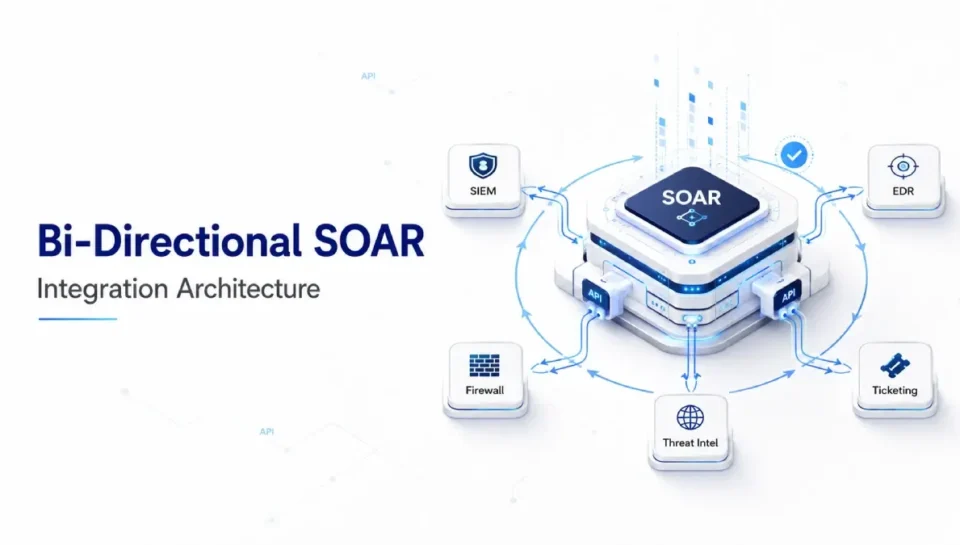
Building a production-grade, bi-directional SOAR workflow requires looking past stateless alerts. True operational success means engineering your connectors for continuous state synchronization, defensive API limits, and industry data standards.
Solving Bidirectional State Synchronization
When System A updates the SOAR platform, and the SOAR platform immediately updates System A, software engineers run into a classic structural loop. They risk creating an infinite mirror of API updates, which is a dangerous race condition. If left unaddressed, this loop can rapidly exhaust your customer’s API quotas and clutter incident history logs with thousands of automated entries.
To build a reliable bi-directional workflow, your development team should implement these three core engineering practices:
- Idempotency Keys and Unique Event IDs: Every transaction must carry a unique, deterministic identifier. This ensures that an action executed multiple times yields the exact same result without creating duplicate alerts or unintended side effects.
- System Origin Tagging: Custom connectors must implement explicit user-agent strings or custom system metadata tags, such as updated_by_soar = true. This metadata allows your core application’s API to recognize and ignore updates that your own automation grid originally triggered.
- Mapping the State Machine: Disparate lifecycle statuses must be normalized. For example, mapping an “In Progress” status in an Endpoint Detection and Response (EDR) tool to an “Under Investigation” status in a SOAR incident pane requires an explicit, hardcoded translation matrix to prevent logic mismatches.
Defensive API Engineering: Surviving Enterprise Scale
Enterprise security environments operate at an immense scale, and engineering teams must build tools that expect a high volume of noise. Data compiled in an analysis by Vectra AI highlights that 76% of organizations cite alert fatigue as a primary concern for their security teams. This issue is heavily compounded by the fact that 73% of security practitioners identify false positives as their number one operational challenge.
If a client organization faces a sudden alert storm, an integration that is not built defensively will drop critical data packets, hit rigid API rate limits, or completely lock up the automated pipeline. Your development team must design the integration layer to gracefully handle unexpected performance spikes using three defensive mechanisms:
- Handling HTTP 429 Errors: Your connector code must programmatically read rate-limit headers like Retry-After. It should implement exponential backoff with random variations (often called jitter) to stagger retries without overloading the target server.
- Proactive Token Lifecycle Management: Integrations should handle OAuth2 token refreshes silently in the background. If a token refresh cycle fails or times out during a critical security event, the entire automated response grid drops offline exactly when the customer needs it most.
- Backpressure and State Management: Standardize on stateless architecture models inside your connector containers. This isolation ensures that sudden spikes in security telemetry do not bleed into other operational areas of the platform.
A production-grade security integration typically spends roughly twenty percent of its codebase executing core tasks, such as fetching and pushing data. The remaining eighty percent of the code is dedicated entirely to exception handling, rate-limiting compliance, and log sanitization.
Playing Nice with the Schema: Normalization Standards
When a SOAR playbook runs during an incident, it links multiple integrations together. For example, a single workflow might fetch an IP address from an endpoint tool, check its reputation on a threat intelligence platform, and then block it via an enterprise firewall. If your custom integration outputs a completely unique, unmapped JSON payload, security engineers are forced to write complex regular expressions to pass data between steps. This builds massive operational debt.
Data complexity is a major hurdle for modern enterprises. Research on data ingestion challenges notes that the typical enterprise runs anywhere from 40 to 80 distinct security controls, each formatting its alerts differently. To solve this friction, the security ecosystem has rallied around data standardization frameworks.
The Open Cybersecurity Schema Framework (OCSF) has emerged as a major vendor-agnostic standard. According to data published by Amazon Web Services, the OCSF community expanded rapidly to include more than 200 participating organizations and 800 contributors by late 2024.
Furthermore, an international momentum shift occurred when member states of the International Telecommunication Union backed OCSF for official ratification as a global standard. Engineering your SOAR platform integration to match native schemas like Cortex XSOAR’s common server code or the open OCSF framework guarantees that your product fits cleanly into a customer’s pre-existing automated playbook.
Passing the Vendor Marketplace Certification Gauntlet
Building a functional integration in a localized development sandbox is a significant achievement. However, listing that connector on major commercial hubs like the Palo Alto Networks Marketplace, Splunkbase, or the Microsoft Sentinel Content Hub requires navigating a strict evaluation process. Marketplace reviewers enforce rigid quality gates to protect enterprise buyers from buggy or insecure code.
To ensure your custom SOAR connector passes review cycles smoothly, your engineering team should adhere to a strict readiness checklist:
- Zero Hardcoded Secrets: Reviewers will instantly reject apps that store API tokens or private keys in plain text. Your code must utilize the native, encrypted credential store provided by the host SOAR platform.
- Automated Validation and Linting: Utilize ecosystem validation tools during your development pipeline. For instance, teams building for Palo Alto Networks should run native validation scripts to check for compliance with design guidelines before submitting code.
- Comprehensive Offline Unit Testing: Most platforms require a minimum of 80% test coverage. Because certification reviewers cannot log into your proprietary live production software, you must use mock libraries to simulate API responses for every potential error code.
The Real Cost of “Integration Debt”
Building a custom SOAR integration is not a one-time configuration task. It is a continuous software development project. Third-party vendor APIs evolve, authentication protocols get upgraded, and underlying platform architectures change. This ongoing reality creates integration debt, which can easily divert your core software engineers away from your primary product roadmap.
With cybercrime threats escalating, security teams cannot afford broken automation workflows. Reports show that the average cost of a data breach rose to 4.88 million dollars, emphasizing the high stakes of enterprise protection. Software vendors must decide whether to spend internal engineering resources on connector upkeep or leverage dedicated integration experts.
This is where ForshTec helps your team scale. ForshTec specializes in designing, certifying, and maintaining enterprise-grade SOAR integrations. By partnering with us, you can deliver seamless marketplace-ready connectors to your clients, accelerate your enterprise sales cycles, and keep your internal product teams focused on building your core software platform.