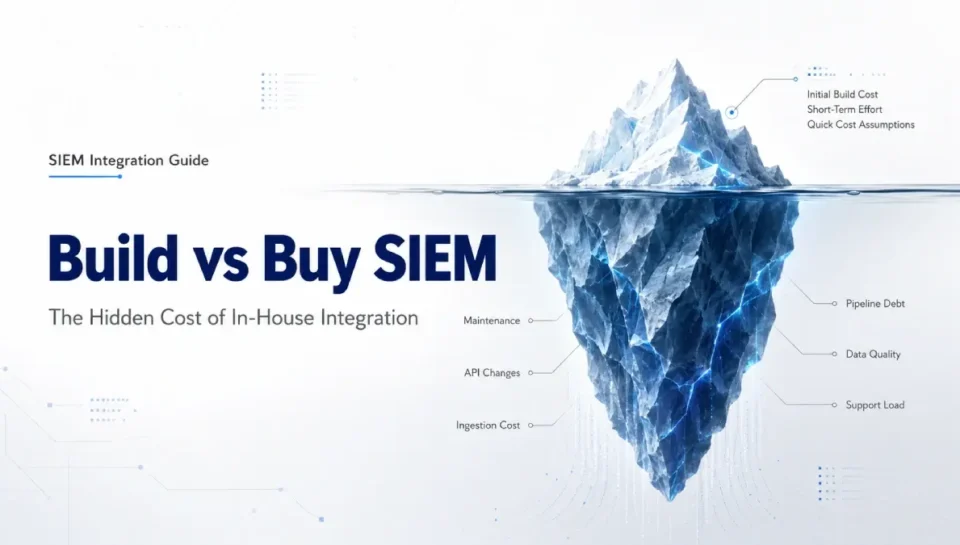

When engineering and security leaders sit down to evaluate whether to build or buy a SIEM platform integration, the conversation almost always follows a highly predictable, outdated script. The product manager calculates the cost of pulling two developers off the core feature roadmap for a few weeks, compares it against the annual subscription cost of a pre-built commercial connector, and attempts to make a binary decision based on initial deployment speed.
This traditional framework misses the reality of modern security data architecture.
In today’s cloud-heavy enterprise environments, the financial risk of building an in-house integration is no longer just about developer salaries or initial code quality. The real crisis lies in security data gravity, unoptimized telemetry pipelines, and the massive data ingestion taxes levied by modern cloud SIEM platforms. Choosing to build a custom logging pipeline from scratch without a dedicated infrastructure team is often a fast track to unpredictable budget overruns and permanent engineering debt.
The True Cost of In-House Architecture: Developer Time vs. Integration Debt
The first flaw in the basic build-vs-buy calculation is treating integration development as a finite project with a clear end date. In reality, writing the initial code represents roughly twenty percent of the total lifecycle cost of a connector. The remaining eighty percent is spent on long-term maintenance, edge-case debugging, and modifying pipelines to match upstream API changes.
The math behind pulling specialized internal talent to build standard infrastructure lines up poorly:
- The Opportunity Cost: Diverting senior software engineers away from your primary product roadmap directly delays core business features that drive revenue.
- The Maintenance Tail: Every time a cloud provider changes an authentication method or a SIEM vendor updates their ingestion schema, your in-house integration breaks. This forces engineering teams into a continuous cycle of emergency patching.
- Personnel Overhead: Managing a portfolio of custom integrations requires a dedicated slice of engineering overhead. For a growing vendor or a scaling enterprise, maintaining dozens of custom connections eventually requires hiring full-time engineers solely to prevent data pipelines from collapsing.
The Data Ingestion Crisis: Surviving the Telemetry Boom
Beyond the engineering hours required to keep a script alive, modern architectures introduce a major financial challenge: variable data ingestion penalties.
Enterprise technology footprints are expanding rapidly across multi-cloud environments, microservices, and identity layers. This expansion has caused the volume of raw security telemetry to balloon exponentially. Because prominent cloud SIEM platforms utilize pay-by-ingest licensing models, streaming unoptimized, raw log files directly into your security analytics layer can cause annual SIEM costs to spike unexpectedly.
When you build a basic, standard integration script in-house, it typically acts as a simple pass-through pipe, dumping raw JSON payloads directly into the SIEM. Without highly complex filtering logic, data masking rules, and deduplication engines built directly into your connector code, you are effectively paying an enormous, unforced ingest tax on useless, repetitive log data.
A production-grade integration layer does not just move data; it actively manages it. It parses, standardizes, and drops low-value telemetry at the edge, ensuring that only actionable, high-fidelity security events cross the ingestion threshold. Building and maintaining this style of intelligent data-decoupling infrastructure internally turns your software team into pipeline optimization engineers, completely shifting their focus away from your company’s core value proposition.
Evaluating Your Options: A Structural Comparison
To understand where your resources are best utilized, it helps to view the structural differences across the integration lifecycle:
| Dimension | Building In-House | The Managed Integration Approach |
|---|---|---|
| Time-to-Market | Months of development and testing cycles | Immediate operational deployment |
| Pipeline Maintenance | Handled by internal engineering sprints | Covered by continuous, external SLAs |
| Upstream API Resiliency | Requires manual debugging when pipelines break | Proactively updated and managed automatically |
| Data Optimization | Raw, uncompressed data streams drive up costs | Intelligent filtering minimizes ingestion fees |
| Financial Predictability | Variable capital and engineering expenses | Predictable operational expenditure |
The Compliance and Data Quality Trap
Security data is not standard operational noise; it serves as legal audit material. If an internally built logging pipeline drops data packets during a high-volume network event, or fails to properly handle an API rate-limit error, it creates silent blind spots in your audit trail.
Furthermore, different security systems format identical data types in vastly different ways. If your custom integration requires security operations teams to write highly manual parsing rules for every new log type, you are simply shifting the engineering burden onto your security analysts. Aligning your pipelines with modern, vendor-agnostic frameworks like the Open Cybersecurity Schema Framework (OCSF) requires deep architectural expertise that off-the-shelf, home-grown scripts rarely provide.
The Alternative Strategy: Custom Engineering Without the Overhead
The choice between building and buying does not have to be a rigid trade-off between complete internal ownership or a restrictive, generic third-party software license. There is a smarter, hybrid path: outsourcing your integration infrastructure to specialized development experts.
This is the precise gap that ForshTec fills. ForshTec builds, certifies, and manages enterprise-grade SIEM and data pipeline integrations tailored exactly to your technical specifications. By treating integration design as a specialized discipline, we deliver robust, highly optimized connectors that shield you from unpredictable ingestion taxes and permanent maintenance debt.
Partnering with ForshTec allows your enterprise to unlock seamless marketplace visibility and comprehensive data connectivity, while keeping your core internal engineering team completely focused on what matters most: building your product.