
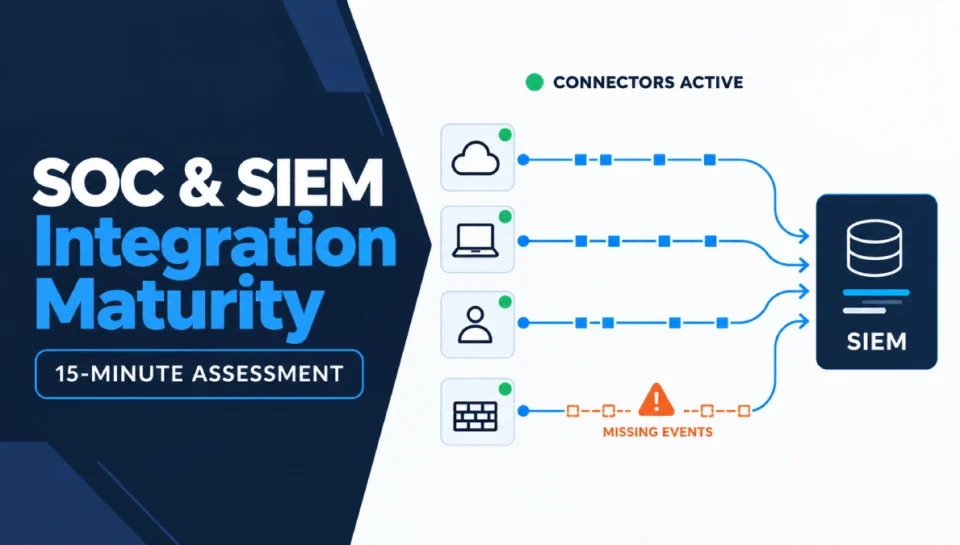

Your SIEM dashboard shows healthy connectors. But does that mean your SOC is seeing everything it should?
Not necessarily.
Critical events can go missing, logs can arrive without context, and detection rules can operate on incomplete data, even when integrations appear active.
That’s the gap between connectivity and integration maturity. Here’s how to assess yours in 15 minutes.
What Does SOC and SIEM Integration Maturity Actually Measure?
A Security Operations Center (SOC) depends on data from endpoints, identity providers, cloud platforms, networks, and security applications.
A Security Information and Event Management (SIEM) platform brings that data together for monitoring, correlation, and threat detection.
But connecting these systems is only the starting point.
Integration maturity measures whether the data moves reliably between platforms, maintains its quality, and supports the workflows analysts depend on.
It comes down to five areas:
- Coverage: Are the right security events being collected?
- Reliability: Do integrations consistently deliver those events?
- Data quality: Is the information accurate and usable?
- Detection readiness: Can the SOC identify suspicious activity?
- Response integration: Can analysts investigate and act without losing context?
Together, these provide a practical way to evaluate the integration layer of your SOC.
The 15-Minute SOC & SIEM Integration Maturity Assessment
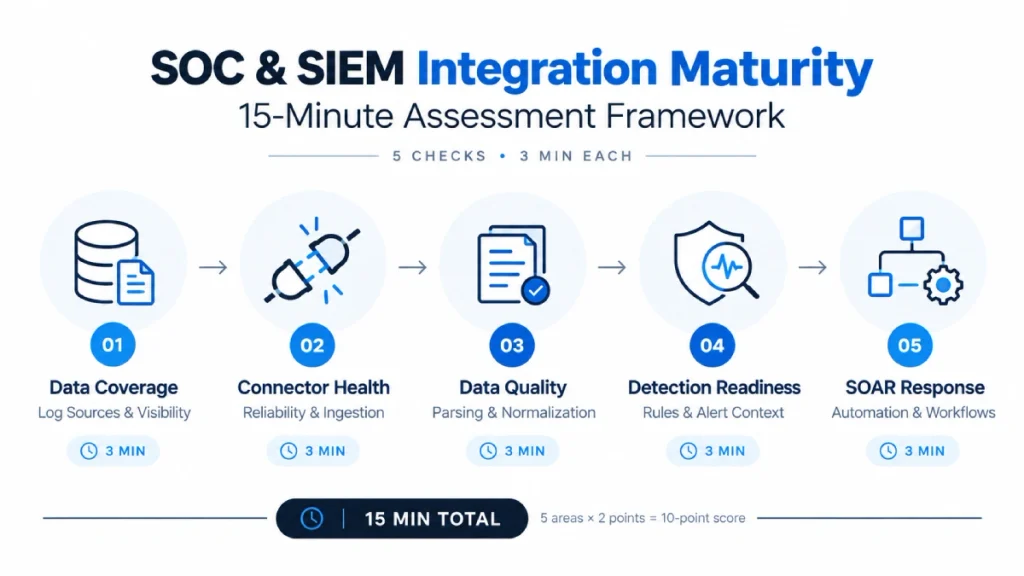
You don’t need to examine every connector to identify early signs of integration problems.
Start with five areas, spending approximately three minutes on each. Use recent monitoring data, event samples, and workflow records wherever possible.
1. Check Your Security Data Coverage (3 Minutes)
Start by reviewing which systems feed security data into your SIEM.
A typical environment might include endpoint detection tools, firewalls, cloud workloads, identity systems, and business applications.
The important distinction is between having a connected source and collecting the events your detection rules actually need.
Check the following:
- Are business-critical systems sending relevant security logs?
- Are any applications or cloud services missing?
- Can you identify which detection rules depend on each source?
A large connector inventory can still leave meaningful security gaps.
2. Review SIEM Connector Health and Reliability (3 Minutes)
An active connector does not necessarily mean a healthy data pipeline.
Authentication failures, API rate limits, expired tokens, and changes in upstream systems can interrupt collection without immediately making the integration appear disconnected.
Review:
- Last successful event ingestion.
- Delayed or missing log records.
- Connector errors and retry mechanisms.
- Alerts for unexpected ingestion failures.
The goal is to understand whether your SOC can identify collection problems before they affect detection.
3. Evaluate Data Normalization and Quality (3 Minutes)
Getting security data into the SIEM is one part of the job. Making that data useful is another.
Different tools generate events using different formats and field names. Without proper parsing and normalization, correlating activity across platforms becomes difficult.
Take a few sample events and examine whether:
- Timestamps and identifiers are consistent.
- Important event fields are correctly mapped.
- Logs follow applicable schemas such as ECS or OCSF.
- Analysts can correlate related activity across sources.
A successfully ingested event can still be unusable if the information it carries is incomplete or incorrectly mapped.
4. Test Detection Readiness (3 Minutes)
Now consider what happens after the SIEM receives the data.
Choose an important detection use case, such as suspicious privileged-account activity, and trace how the underlying events become an alert.
Check whether the required telemetry is available, the detection logic has been tested, and the alert contains enough context for investigation.
The MITRE ATT&CK detection strategies offer a useful reference for connecting threat behaviors with relevant analytics.
A functioning detection rule means little if the events it depends on never arrive.
5. Examine Response and SOAR Integration (3 Minutes)
The final check concerns what happens after an alert is generated.
If your SOC uses a Security Orchestration, Automation, and Response (SOAR) platform or case-management system, follow an alert through that workflow.
Look for:
- Accurate transfer of alert details and evidence.
- Clear incident ownership and escalation.
- Visibility into failed automation steps.
- Approval controls and audit records for response actions.
If analysts repeatedly copy information between systems, the integration may be creating more work than necessary.
How to Calculate Your SOC & SIEM Integration Maturity Score?
Once you’ve completed the five checks, assign each area a score between 0 and 2.
| Score | What It Means |
| 0 — Unverified | The capability is missing or cannot be validated. |
| 1 — Developing | The capability exists but has reliability or coverage gaps. |
| 2 — Verified | The capability works and has recent supporting evidence. |
Add your scores to calculate a total out of 10.
How to interpret your results:
- 0–3: Foundational gaps. Prioritize missing integrations and unreliable data flows.
- 4–7: Developing maturity. Focus on normalization, connector monitoring, and workflow consistency.
- 8–10: Stronger integration foundation. Continue validating detections and monitoring integration health.
This is a preliminary self-assessment, not a certified industry maturity model. Even a high score deserves closer examination if a critical source or workflow scores zero.
What Should You Do After Benchmarking Your SOC?
Your score is useful only when it helps identify the next engineering priority.
If coverage is weak, start by mapping missing data sources to critical detection use cases.
If connector reliability is the concern, review authentication handling, retries, checkpoints, and ingestion monitoring.
For data-quality problems, examine parsers and field mappings. Where response workflows fall short, investigate how context moves between SIEM, SOAR, and case-management platforms.
The objective is not simply to achieve a higher maturity score. It is to understand which integrations need attention and why.
Conclusion: Integration Maturity Goes Beyond Connectivity
A SOC can have every major security tool connected and still struggle with incomplete visibility, unreliable data pipelines, and disconnected response workflows. The number of integrations matters less than how well those integrations support detection and investigation.
The SIEM brings security data together. The SOC turns that information into decisions. Reliable integrations are what make that exchange possible.
That is why “Are our security tools connected?” is no longer enough. The more useful question is “How well are those connections actually working?”
ForshTec Systems builds and maintains SIEM, SOAR, and XDR integrations, helping security teams and vendors improve connector reliability, data normalization, and workflows across their security stack. If your 15-minute maturity assessment reveals gaps in coverage, data quality, or response integration, we’re happy to talk through what your integration architecture needs to support.