

If you sell an application security or cloud security product, you may hear this question late in an enterprise deal: “How does this get into ServiceNow?”
By that point, the buyer may already like the product. The demo went well and the security team sees the value.
But finding a security issue is only the first step. Someone still needs to own it, fix it, and track it.
For many large companies, that work happens in ServiceNow.
Why ServiceNow Integration Matters for Security Vendors?
Security tools can find hundreds or even thousands of issues. But those findings only help when the right team can act on them. Many companies already use ServiceNow to:
- Assigning ownership,
- Tracking remediation,
- Managing SLAs,
- Connecting issues to business services,
- Handling incidents and changes.
So when a buyer asks whether your product integrates with ServiceNow, they are really asking: Can the issues your product finds move into the workflow our teams already use?
That is why integration matters.
AppSec and Cloud Security Have the Same Remediation Problem
Application security and cloud security solve different problems, but both lead to the same next step: someone has to fix what was found.
1. Application Security Findings Need the Right Owner
An application security tool may find a vulnerability, but the finding still needs to reach the team that owns the affected application. That means the finding should include things like:
- The affected application,
- The related system or service,
- Who owns it,
- How urgent it is,
- When it needs to be fixed.
Once that information reaches ServiceNow, the issue can move into the company’s normal remediation process.
The difference is simple: finding the problem vs. getting the problem fixed.
2. Cloud Security Findings Need the Same Path
Cloud security tools may find risky settings, configuration problems, or policy issues. Those findings still need to answer basic questions:
- What is affected?
- Who owns it?
- How serious is it?
- What needs to happen next?
ServiceNow can help route those findings to the right people and track the work until it is closed.
So whether the product is focused on AppSec or cloud security, the goal is the same: move findings from detection to remediation.
Why Saying “We Integrate With ServiceNow” Is Not Enough?
A basic connection is not always enough. For the integration to be useful, the data needs to reach ServiceNow in the right way.
1. The Finding Has to Be Linked to the Right Asset
If a security issue is linked to the wrong application, server, or service, the rest of the process can go wrong too. It may be:
- Sent to the wrong team,
- Given the wrong priority,
- Assigned the wrong deadline.
That is why asset mapping matters. In simple terms, ServiceNow needs to know what the finding belongs to.
2. Findings Need to Arrive in a Consistent Format
Different security products describe findings differently. They may use different:
- Severity levels,
- Identifiers,
- Data formats,
- Naming conventions.
The integration needs to translate that information into a format ServiceNow can use. It also needs to handle duplicate findings properly.
Otherwise, one issue can create many separate tickets and make the workflow harder instead of easier.
3. ServiceNow Keeps Changing Too
An integration is not built against a platform that stays the same forever.
ServiceNow continues to update its security workflows, data models, APIs, and products. The security vendor’s product will also continue to change.
That means the integration has to keep up with both sides. A connector that worked well when it launched may need updates later as either platform changes.
A ServiceNow Integration Is an Ongoing Commitment
This is one of the easiest parts to underestimate. Building the first version of the connector is only the beginning. Over time, the team may need to deal with:
- API changes,
- Authentication updates,
- New ServiceNow releases,
- Changes to the security product,
- Data model updates,
- Customer-specific requirements.
That makes the integration an ongoing maintenance responsibility rather than a one-time development task. For a growing security company, that creates another question: who should own all of this work?
Should You Build the ServiceNow Integration In-House?
Security vendors generally have two ways to approach the problem.
1. Build and Maintain It Internally
Building the integration in-house gives the product team direct control. But it also means engineers need to spend time learning and maintaining ServiceNow-specific integration work alongside the company’s core product.
For a lean team, that can become a trade-off.
Every sprint spent working on connector logic, data mapping, and maintenance is also time that is not being spent improving the product’s main security capabilities.
2. Treat Integration as a Specialized Function
The other option is to separate connector work from the core product roadmap.
That means treating ServiceNow integration as its own specialized function, with people focused on building, maintaining, and updating the connector while the product team stays focused on detection.
The goal is not to avoid the integration work. It is to decide where that work should live.
What Buyers Are Really Asking When They Mention ServiceNow?
When a buyer says: “How does this get into ServiceNow?”, they are rarely asking only whether an API connection exists. They want to know whether findings from your product can move into the systems where their teams already:
- Assign work,
- Set priorities,
- Track progress,
- Manage SLAs,
- Close security issues.
That makes the ServiceNow integration part of the overall product experience, even if the actual detection happens somewhere else.
Detection Starts the Process. Remediation Finishes It.
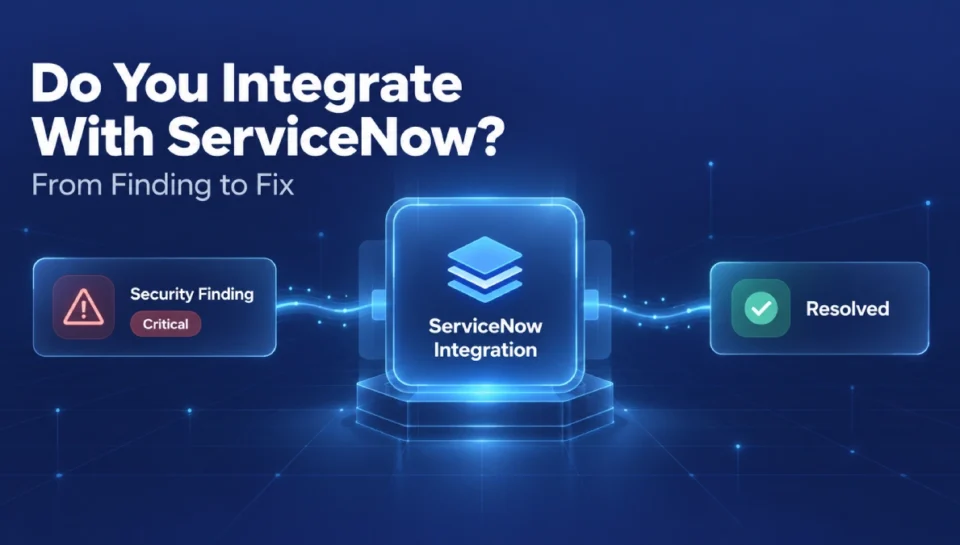
A security product can be great at finding problems and still create friction if customers cannot easily move those findings into their existing workflows. For companies already using ServiceNow, the integration connects those two parts.
The security product finds the issue. ServiceNow helps teams manage what happens next.
That is why “Do you integrate with ServiceNow?” can become a deal-deciding question.
ForshTec builds and maintains ServiceNow SecOps integrations for security vendors, helping move application security and cloud security findings into the workflows enterprise teams already use for remediation. We handle the connector layer so security vendors can stay focused on their core detection capabilities. If ServiceNow integration is becoming part of your enterprise sales conversations, we’re happy to talk through what the integration needs to support.