
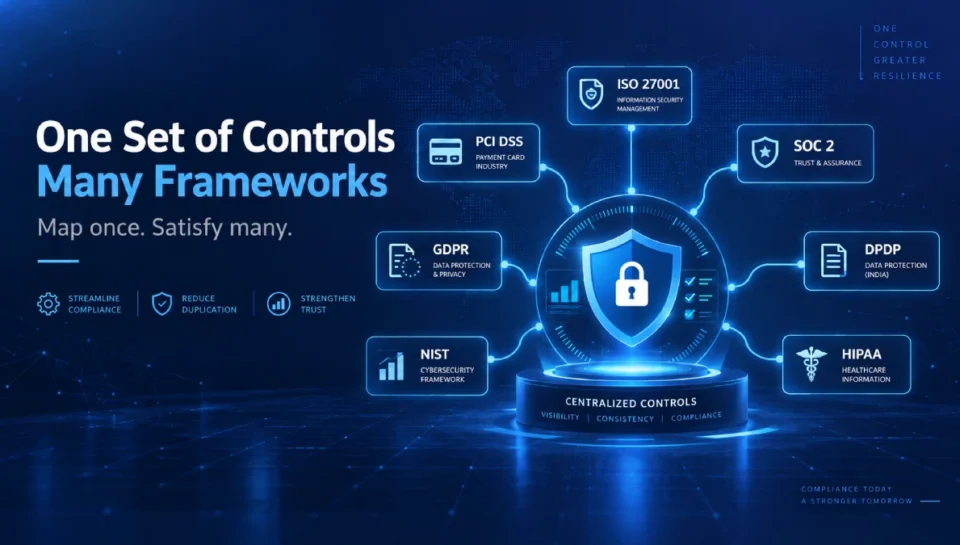

Most organisations aren’t chasing one compliance framework. They’re chasing several at once: a customer contract that demands SOC 2, a payments requirement under PCI DSS, an ISO 27001 certification the market expects, a data-protection obligation under GDPR or India’s DPDP Act, and a sector regulator on top of all of it.
Treated as separate projects, each with its own evidence, its own tooling, and its own scramble, this becomes enormously expensive. But that’s a self-inflicted cost. At the control layer, the actual technical and operational measures these frameworks overlap far more than they differ.
The frameworks disagree less than they appear to
Strip away the differing vocabulary and clause numbering, and a common core of controls appears in almost every major framework:
- Logging and monitoring: capturing and reviewing activity across systems, and retaining it.
- File integrity monitoring: detecting unauthorised changes to critical files and configurations.
- Secure configuration and hardening: measuring systems against a defined baseline.
- Vulnerability management: identifying and remediating known weaknesses.
- Access control and accountability: enforcing least privilege and knowing who did what.
- Incident detection and response: being able to notice, investigate, and respond to events.
PCI DSS frames logging and change detection in its own way. ISO 27001 files the same ideas under its Annex A controls. SOC 2 tests them against its Trust Services Criteria. HIPAA’s Security Rule reaches similar requirements from a healthcare angle. NIST’s control catalogues describe them in yet another structure. The words change; the underlying control doesn’t.
Map once, satisfy many
The efficient model inverts the usual approach. Instead of asking “what does each framework need?” and building separately for each, you ask “what controls do I need to operate?” then map each control to every framework requirement it satisfies.
Build centralised logging with a defined retention period once, and it contributes to your PCI DSS, ISO 27001, SOC 2, and data-protection obligations simultaneously. Stand up continuous configuration assessment against a recognised benchmark once, and it feeds hardening requirements across all of them. The control exists in one place, generating one stream of evidence, referenced by many frameworks.
The payoff:
- Less duplicated effort: one implementation instead of five parallel ones.
- A single source of evidence: assessors for different frameworks draw from the same monitored controls rather than bespoke, per-framework artefacts.
- A consistent posture: you’re not strong on the framework you audited last quarter and weak on the one due next quarter.
An honest caveat
Mapping is a force multiplier, not a shortcut to automatic compliance. Two things are worth stating plainly:
- Each framework has requirements that are genuinely its own: governance, documentation, scoping, and process expectations that no shared control will cover. Overlap handles the technical core, not the whole standard.
- Frameworks are versioned, and they move. Requirements change between revisions, and a control mapping that was accurate last year may not be today. Always map against the current published version of each standard, and validate the mapping before you rely on it in an audit.
Done with that discipline, control mapping turns a stack of competing compliance projects into a single, well-instrumented security operation that happens to satisfy all of them.
The takeaway
If compliance feels like paying for the same work several times over, that’s usually a sign the effort is organised around frameworks instead of controls. Reorganise it around the controls, map deliberately, and most of the duplication disappears, leaving you with something more valuable than a stack of certificates: a security posture that actually holds.
ForshSec helps organisations design and set up that shared control layer the logging, monitoring, configuration assessment, and detection foundation that a compliance mapping can be built on. If you’re juggling more than one framework, it’s worth a conversation.