
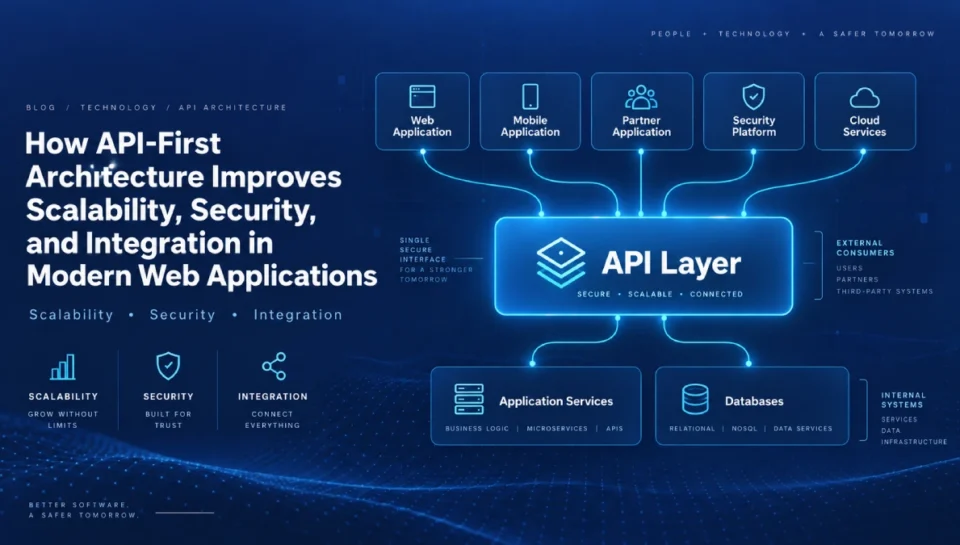

Modern applications rarely serve a single interface. The same backend may need to support a web application, mobile clients, internal tools, partner systems, automation workflows, and external security platforms.
When APIs are designed only after backend implementation, those consumers can become tightly coupled to internal data models and application logic. Authentication patterns vary, integrations require custom work, and seemingly minor backend changes can break downstream systems.
API-first architecture changes the sequence. Teams define the interface, data contracts, security expectations, and expected behavior before implementation begins. Frontend, backend, security, and integration teams can then build against the same agreed contract.
For organizations developing SaaS platforms, security products, enterprise applications, or integration-heavy systems, that discipline can create a more scalable and maintainable architecture while making security and interoperability deliberate design concerns rather than late-stage fixes.
What Is API-First Architecture?
API-first architecture is a software development approach in which teams define and agree on an API contract before building the services and applications that implement or consume it.
The contract describes resources or operations, request parameters, schemas, responses, authentication requirements, and error conditions. For HTTP APIs, the OpenAPI Specification (OAS) is commonly used to create a machine-readable description of that interface. The current OpenAPI specification formally defines an API’s surface and semantics.
That contract can then support:
- Mock servers before backend development is finished
- Interactive documentation through tools such as Swagger UI or Redoc
- Client SDK generation
- Schema validation
- Automated contract testing
- Parallel frontend and backend development
API-first should not be confused with API-only. Internal services do not all need to become public APIs. The principle is that interfaces intended for reuse are designed intentionally rather than emerging accidentally from implementation details.
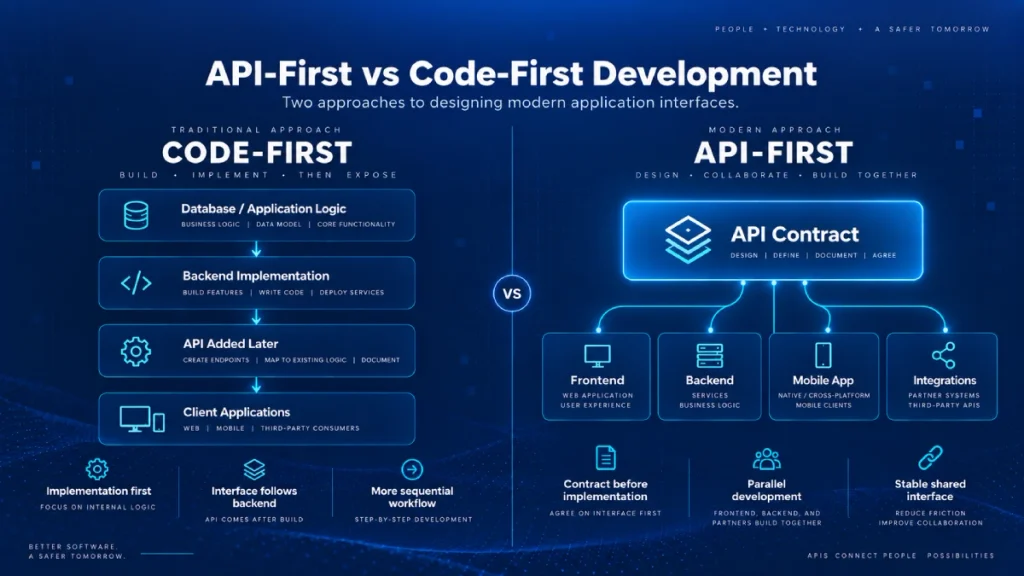
API-First vs Code-First Development
Code-first development commonly starts with application logic or a database model and exposes an API afterward. That approach can work well for prototypes, small internal applications, or systems with a single tightly controlled consumer.
API-first development reverses the order for systems where interfaces are expected to remain stable across teams or consumers.
| Area | API-First | Code-First |
|---|---|---|
| API design | Contract before implementation | Often emerges from implementation |
| Team workflow | Parallel development is easier | Often more sequential |
| Client coupling | Interface can be separated from internal models | Can become backend-specific |
| Documentation | Part of the design process | Often added afterward |
| Integration readiness | Designed intentionally | Frequently retrofitted |
| Version management | Considered earlier | Often addressed when changes occur |
| Testing | Contract tests can begin early | Usually depends more on implementation |
| External consumers | Stable interfaces are easier to govern | Additional adaptation may be required |
Neither model automatically produces good software. API-first becomes particularly valuable when multiple independent consumers depend on the same interface.
Why API-First Architecture Improves Scalability
Scalability is not simply the ability to add more servers. A scalable architecture must also support more teams, more clients, more integrations, and more data without making every change increasingly risky.
Decoupled Clients and Services
A stable API contract allows web, mobile, and partner applications to depend on the interface rather than the underlying implementation.
Backend services can change databases, reorganize internal code, or introduce new infrastructure as long as the agreed external behavior remains compatible.
Independent Service Scaling
API-first architecture also complements microservices. If analytics, authentication, search, or security-event processing is separated into independently deployable services, each workload can be scaled according to its own traffic pattern.
API-first does not require microservices, however. A well-designed monolithic application can also expose carefully governed APIs.
Horizontal Scaling and Statelessness
HTTP itself is defined as a stateless application-level protocol. Designing request processing so that individual application instances do not depend unnecessarily on local session state can make horizontal scaling easier because requests can be distributed across multiple instances.
Caching can reduce repeated backend work, while queues and event-driven processing can move expensive or long-running workloads out of synchronous request paths.
Rate limits and quotas add another layer of resource governance by controlling how consumers use shared capacity.
The benefit becomes particularly visible when an API moves from supporting one frontend to supporting twenty customers, partners, applications, or connectors. A stable contract provides a common integration surface instead of requiring twenty variations of backend logic.
How API-First Architecture Strengthens Security
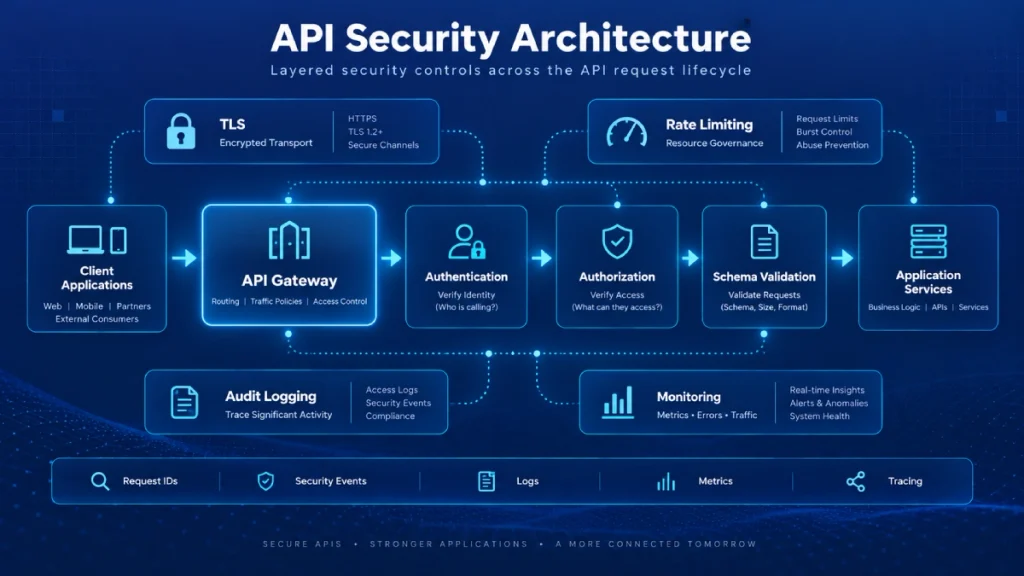
API-first architecture does not automatically make an API secure. Its advantage is that security requirements can become part of design and governance before endpoints reach production.
Authentication
Authentication should establish who or what is calling an API.
OAuth 2.0 is primarily an authorization framework for obtaining limited access to HTTP services; it should not be described as an authentication protocol by itself. OpenID Connect adds an identity layer on top of OAuth 2.0 and provides authentication capabilities.
Depending on the consumer, an architecture may use OpenID Connect, OAuth-based service access, API keys, workload identities, certificates, or other credential models.
Authorization
Successful authentication does not mean a caller should access every resource.
Authorization must be enforced according to business and security requirements through approaches such as RBAC, ABAC, scopes, tenant boundaries, and resource-level policies.
This is particularly important because OWASP’s API Security Top 10 includes Broken Object Level Authorization, Broken Object Property Level Authorization, and Broken Function Level Authorization among major API risks.
Transport and Input Security
APIs carrying sensitive information should use appropriate TLS protection. Requests should also be validated against expected schemas, formats, sizes, and business rules rather than trusting that authenticated callers will always send safe input.
Secrets and signing keys should be managed separately from application source code.
Rate Limiting and Resource Governance
Rate limiting can reduce automated abuse and uncontrolled resource consumption, but it should not be represented as a complete DDoS defense.
OWASP specifically identifies Unrestricted Resource Consumption as an API security risk, making resource limits part of both reliability and security design.
Auditability and Observability
Production APIs should make significant activity traceable through request IDs, security events, audit logs, metrics, and distributed tracing where appropriate.
An API gateway can centralize routing, traffic policies, authentication enforcement, rate limits, and telemetry, while application services still enforce business-specific authorization.
How API-First Architecture Simplifies Integration
A reusable API contract gives internal and external consumers a predictable way to interact with a platform.
For enterprise API integration, predictability often matters as much as endpoint availability. Integrators need to know:
- How authentication works
- Which resources are stable
- How pagination behaves
- Which limits apply
- What errors mean
- Whether webhooks are available
- How changes are versioned
- Which fields are optional
- How retries should behave
Clear documentation and machine-readable contracts reduce assumptions between the API provider and consumer.
SDKs can reduce repetitive client implementation, while webhooks can notify downstream systems when events occur instead of forcing every consumer to poll continuously.
Good API integration architecture therefore involves far more than exposing REST endpoints. It requires lifecycle rules that allow integrations to continue operating as the underlying product evolves.
API-First Architecture for Security Platform Integrations
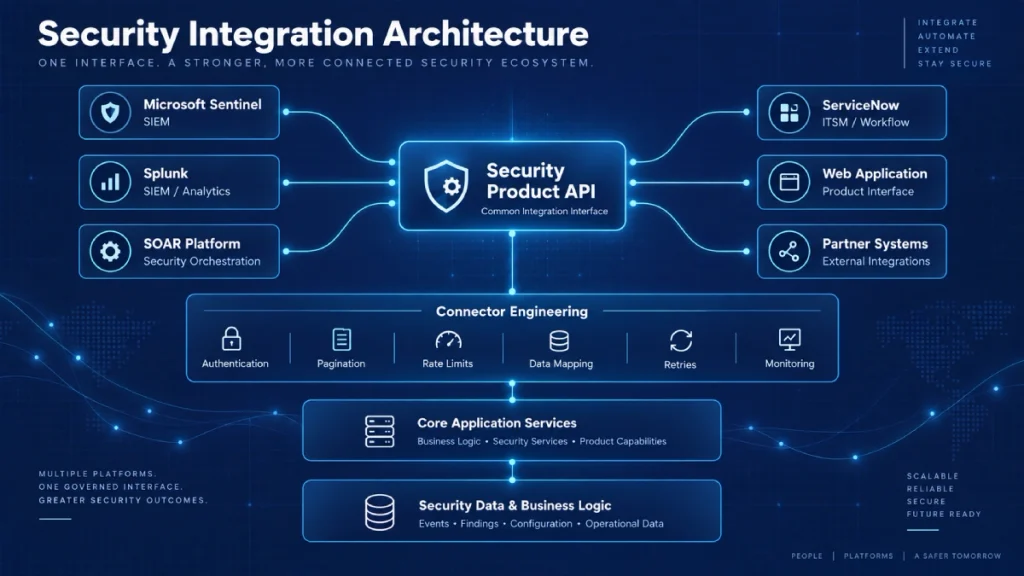
Consider a cybersecurity SaaS product that needs to integrate with Microsoft Sentinel, Splunk, a SOAR platform, ServiceNow, a customer web application, and partner systems.
A simplified architecture could look like this:
Web Application / Sentinel / Splunk / SOAR / ServiceNow / Partners
↓
API Layer
↓
Authentication & Authorization
↓
Core Application Services
↓
Security Data & Business Logic
The API creates a common product interface, but each connector still has operational responsibilities.
A SIEM connector may need to retrieve large volumes of events using pagination, remember checkpoints between executions, respect upstream rate limits, refresh credentials, retry temporary failures with appropriate backoff, and map product-specific fields into the destination platform’s schema.
A ServiceNow integration may use a different authentication model and workflow structure. Another consumer may rely on webhooks rather than polling.
The API contract establishes consistency at the source, while connector engineering handles the requirements of each destination.
For security products, this separation is valuable because the product team can evolve core capabilities without building destination-specific business logic directly into the application.
Choosing Between REST, GraphQL, gRPC, and Webhooks
These patterns solve different problems and can coexist within the same architecture.
REST works well for resource-oriented APIs, external integrations, partner ecosystems, and environments where HTTP conventions and broad interoperability are important.
GraphQL can be useful when clients need flexible access to connected datasets, but teams must consider authorization complexity, caching, query cost, and resource controls.
gRPC is commonly suited to efficient service-to-service communication. The official gRPC documentation describes service definitions using methods, parameters, and return types and supports generated client/server code; Protocol Buffers are its default interface-definition and serialization mechanism.
Webhooks support event-driven notification, allowing systems to react to changes without constant polling. They also require security controls such as endpoint validation, signature verification, replay protection where appropriate, and careful handling of retries.
API-first is a design methodology, not a requirement to choose only one protocol.
How to Implement API-First Architecture
Step 1: Identify API Consumers and Use Cases
Start with consumers rather than database tables. Determine which applications, services, partners, customers, and connectors need access and what each must accomplish.
Step 2: Define Domain Boundaries and Resources
Model business concepts deliberately. Exposing database tables directly creates coupling between storage decisions and external consumers.
Step 3: Create the API Contract
Define operations, schemas, parameters, authentication, responses, and errors. OpenAPI can provide a machine-readable contract for HTTP APIs.
Step 4: Review the Contract
Frontend, backend, product, security, and integration teams should review assumptions before implementation makes them expensive to change.
Step 5: Build Mock APIs
Mocks allow client developers to test requests and responses before production services exist.
Step 6: Define Authentication and Authorization
Document identities, scopes, tenant boundaries, resource access rules, credential handling, and service-to-service access.
Step 7: Develop Against the Contract
Frontend and backend teams can now work independently while targeting the same interface.
Step 8: Automate Contract and Integration Testing
CI/CD pipelines should detect unexpected schema or behavior changes before deployment.
Step 9: Deploy with Monitoring and Governance
Track latency, error rates, traffic, authentication failures, dependency failures, logs, traces, and resource consumption.
Step 10: Manage API Evolution
Establish policies for backward compatibility, deprecation, documentation updates, and breaking changes before external consumers become dependent on undocumented behavior.
API Versioning and Backward Compatibility
Once mobile apps, customers, partners, or security connectors depend on an API, changing that interface becomes a coordination problem.
Breaking changes can include removing fields, changing types, altering required parameters, changing authentication behavior, or modifying resource semantics.
Versioning can be expressed through URI paths such as /v1/, through media types or headers, or through other lifecycle strategies. No single approach is universally best.
More important than the location of a version number is having a clear policy for:
- What counts as a breaking change
- How long previous versions remain supported
- How deprecations are communicated
- How consumers discover migration requirements
Good schema evolution minimizes unnecessary breaking changes and allows additive improvements where possible.
Developer Experience in an API-First Model
Developer experience becomes commercially important when customers and partners must integrate with a product.
A technically capable API can still create friction if developers cannot understand its authentication flow, error behavior, pagination, or data model.
Useful developer experience includes human-readable documentation, OpenAPI descriptions, Swagger UI or Redoc interfaces, working examples, SDKs where appropriate, mock servers, sandbox access, standardized errors, and contract tests.
API-first development helps because documentation and implementation can originate from the same interface definition rather than being maintained as unrelated artifacts.
Common API-First Architecture Mistakes
1. Designing APIs Around Database Tables
Problem: Internal storage models are exposed directly.
Impact: Schema changes become external breaking changes.
Better approach: Create stable domain models or DTOs that separate public contracts from persistence.
2. Inconsistent Error Responses
Problem: Every endpoint returns errors differently.
Impact: Consumers must build special handling for individual operations.
Better approach: Define predictable error codes, structures, and retry semantics.
3. Weak Authorization
Problem: Authentication succeeds, but object or function access is insufficiently checked.
Impact: Users may access resources outside their intended permissions.
Better approach: Enforce authorization at the relevant resource and business-operation level.
4. Ignoring Pagination
Problem: Endpoints return unbounded datasets.
Impact: An API that works with hundreds of records may become expensive or unreliable with millions.
Better approach: Define predictable pagination and incremental retrieval from the beginning.
5. Ignoring Rate Limits
Problem: Providers expose unlimited operations or consumers assume unlimited capacity.
Impact: Traffic spikes can cause failures and integrations may break when platform limits are encountered.
Better approach: Publish limits and design consumers to handle throttling deliberately.
6. Breaking Existing Consumers
Problem: An apparently minor change alters an established contract.
Impact: Mobile clients, partners, and connectors can stop functioning.
Better approach: Test compatibility and use controlled deprecation.
7. Treating Documentation as an Afterthought
Problem: Documentation and implementation diverge.
Impact: Integrators build against incorrect assumptions.
Better approach: Generate and validate documentation from governed contracts where practical.
8. Ignoring Observability
Problem: Teams know an integration failed but cannot determine where.
Impact: Distributed failures become expensive to troubleshoot.
Better approach: Design logging, metrics, traces, correlation IDs, and actionable error reporting into production APIs.
When Should Businesses Adopt API-First Architecture?
API-first architecture is particularly valuable when a product must support multiple independent consumers.
Typical candidates include:
- SaaS platforms
- Web and mobile products sharing backend services
- Security products
- Products with third-party integrations
- Partner ecosystems
- Microservice environments
- Enterprise platforms
- Developer-facing products
- Applications expected to expand into additional channels
The more external dependencies an interface accumulates, the more costly uncontrolled API change becomes.
When API-First May Be Unnecessary
A disposable prototype, proof of concept, very small internal tool, or single-consumer application may not justify a formal API governance program.
The important question is not simply how small the application is today. Teams should consider whether it is likely to gain additional clients, integrations, partners, or services later.
A lightweight API-first process can also be appropriate. The goal is architectural clarity, not bureaucracy.
What Makes an API Production-Ready?
An endpoint returning JSON is not automatically a production-grade API.
Production readiness typically requires coordinated decisions around authentication, authorization, TLS, schema validation, pagination, rate limits, timeouts, retries, idempotency, error models, versioning, testing, observability, documentation, and deprecation.
Retry behavior deserves particular attention. HTTP defines methods such as PUT and DELETE as idempotent by their intended semantics, while automatically retrying non-idempotent operations requires additional safeguards.
Reliability therefore depends on both provider and consumer design.
For integrations, teams also need to account for expired credentials, partial failures, upstream downtime, duplicate deliveries, delayed events, malformed data, and changes in third-party APIs.
Building Integration-Friendly Products with API-First Engineering
Organizations planning to integrate with enterprise or security ecosystems should consider integration requirements during product design, not after customers request the first connector.
An integration-friendly API normally needs stable identifiers, consistent authentication, documented rate limits, filtering, pagination, incremental synchronization, useful errors, versioning policies, and clear schemas.
Webhooks can improve event-driven workflows, while sandbox environments make partner development safer. APIs that expose timestamps or cursors suitable for incremental collection can also make connector synchronization more efficient.
These details determine whether integrating a product takes straightforward engineering or repeated reverse engineering.
For security vendors and SaaS companies, API readiness therefore becomes part of ecosystem readiness.
How ForshTec Supports API-Driven Security Integrations
ForshTec focuses on the engineering layer that connects security products with the ecosystems their customers already operate.
Its current security connector development capabilities cover SIEM, SOAR, and XDR integrations and include API feasibility, integration engineering, production testing, and connector lifecycle considerations. ForshTec also describes its integration approach around secure authentication, resilient synchronization, and ECS/OCSF-aligned normalization where appropriate.
For an API-driven security product, that work goes beyond calling an endpoint. Authentication renewal, pagination, checkpointing, rate-limit behavior, data transformation, retries, schema compatibility, and operational monitoring must function together.
ForshTec also develops CSPM integrations that connect cloud-security findings with SIEM, SOAR, and workflow platforms, including OCSF-aligned normalization for relevant multi-cloud use cases.
The objective is to build integrations that remain maintainable as both source APIs and destination platforms evolve.
Frequently Asked Questions
What is API-first architecture?
API-first architecture is an approach in which the API contract is designed before the applications and services that implement or consume it. Teams define resources, operations, schemas, authentication, responses, and errors first, then build against that agreed interface. Machine-readable specifications such as OpenAPI can support documentation, mocks, testing, and client generation.
What is the difference between API-first and code-first development?
API-first development begins with an intentional interface contract. Code-first development generally starts with implementation and exposes an API from that implementation later. Code-first can be appropriate for simple systems, while API-first becomes increasingly useful when multiple teams, customers, applications, or partners depend on a stable interface.
Is API-first architecture the same as microservices?
No. API-first is an interface-design methodology, while microservices are an architectural approach that separates a system into independently deployable services. They work well together because stable contracts help services communicate, but API-first can also be used with modular monoliths and other application architectures.
How does API-first architecture improve scalability?
API-first architecture can reduce coupling between consumers and implementation, allowing components and clients to evolve independently. Stable interfaces also make it easier to add more consumers without creating custom backend logic for each one. Actual runtime scalability still depends on infrastructure, data architecture, caching, asynchronous processing, stateless design, and other engineering choices.
How does API-first architecture improve security?
It does not automatically make an API secure. Instead, API-first design allows authentication, authorization, resource limits, schemas, error handling, and other security requirements to be discussed before implementation. This can make security controls more consistent and easier to test across the API lifecycle.
What is OpenAPI in API-first development?
OpenAPI is a specification for describing HTTP APIs in a machine-readable format. An OpenAPI Description can define operations, parameters, schemas, responses, security requirements, and other aspects of an API surface. Tooling can then use that description for documentation, validation, mocks, testing, and code generation.
Is REST required for API-first architecture?
No. API-first describes how an interface is designed, not one specific communication style. Teams can apply contract-first thinking to REST APIs, GraphQL schemas, gRPC service definitions, asynchronous interfaces, and other integration patterns. A platform may also use more than one style depending on its consumers and performance requirements.
When should a business use API-first architecture?
API-first is especially useful when a platform will support multiple frontends, third-party integrations, partners, mobile applications, microservices, security connectors, or a public developer ecosystem. It is also valuable when backward compatibility and interface governance are important. Very small temporary applications may require a lighter process.
Conclusion
API-first architecture creates a clear boundary between what a platform promises to its consumers and how that platform is implemented internally.
That boundary becomes increasingly important as an application gains additional clients, services, partners, and enterprise integrations. Stable API contracts reduce coupling, while early security design helps teams define authentication, authorization, validation, and resource controls before production. Versioning and governance protect downstream consumers as the product evolves.
For security and integration-heavy products, the API is also the foundation on which connectors and automation ecosystems depend.
Planning an API-driven security product or enterprise integration? ForshTec helps engineering teams design and build production-grade security integrations and connectors with scalability, interoperability, and security considered throughout the integration lifecycle. Talk to the ForshTec engineering team about your integration requirements.