

Every security vendor knows the feeling.
Everything will go right: a promising deal moves through evaluation, the product demo goes well, the buyers also sound interesting. But one thing that keeps lingering: “Does it integrate with our stack?”
For new security products, that question can be surprisingly expensive to answer.
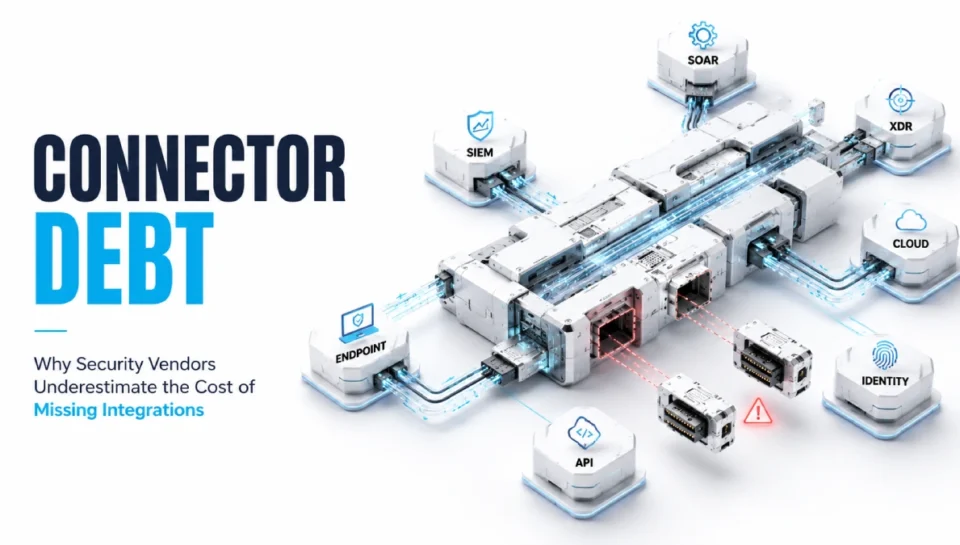
Over time, the gap between the integrations customers expect and the integrations a vendor can actually ship becomes connector debt.
Like technical debt, connector debt rarely announces itself. Instead, it appears as:
- Slipped deals,
- Delayed onboarding,
- Growing roadmap pressure,
- Engineers pulled away from core product development.
Connector Debt Is a Go-to-Market Problem
It is easy to treat integrations as backlog work, something to address once the core product is more mature.
For security products, connectors sit directly on the revenue path.
A SIEM, SOAR, XDR, or security data platform has to operate within the customer’s existing environment. If a prospect depends on a data pipeline or detection stack your product cannot connect with, the evaluation becomes harder and may stop altogether.
The problem is not necessarily product quality. The buyer is weighing the integration work required to adopt it.
Every missing connector can close a door
That changes how connector coverage should be viewed.
It is not simply a feature request queue.
Each missing integration can represent a segment of the pipeline that is harder to reach. Connector coverage determines which environments your product can enter without requiring the customer to take on additional integration work.
Why Series A–C Vendors Feel Connector Debt Most?
Vendors between Series A and Series C tend to experience this problem more sharply for a few structural reasons:
1. Connector catalogues start small
Early products usually launch with integrations required by their first design partners.
That makes sense initially. The problem starts when the connector catalogue fails to keep pace with where the sales team is now selling.
2. Integration work competes with the core roadmap
At this stage, many vendors do not have a dedicated integration team.
The same engineers responsible for the core product are also asked to build connectors. Every connector therefore carries an opportunity cost in roadmap velocity.
3. Buyer Environments become more diverse
As the company moves upmarket and enters new segments, the number of platforms it is expected to support grows.
The range of customer stacks can widen faster than a small engineering team can cover.
4. Every connector creates ongoing maintenance
Connectors are not build-once artefacts. Over time:
- Upstream APIs change,
- Schemas drift,
- Authentication models are deprecated,
- Existing integrations require updates.
Each connector that ships becomes another integration the team has to maintain.
This is where the cost is often underestimated. The real expense is not simply the week spent building a connector. It is the continuing engineering effort required to keep that connector working while the platform on the other side changes.
Three common ways teams respond
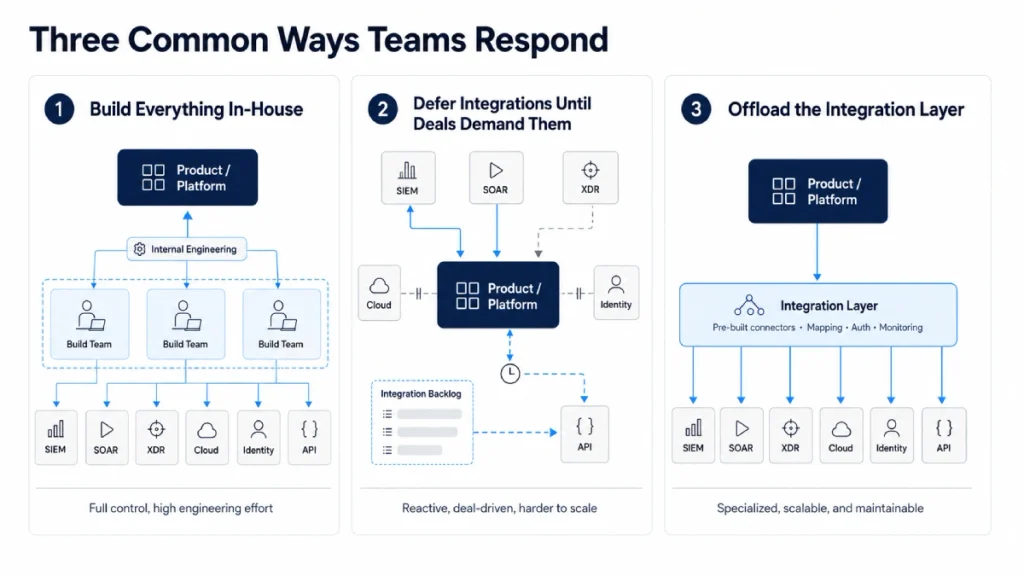
Most vendors eventually fall into one of three approaches:
1. Build everything in-house
Building connectors internally provides full control, but it is also expensive in engineering time.
For a small team, every connector sprint is time that cannot be spent on the product’s core differentiator.
2. Defer integrations until deals demand them
Another approach is to push integrations to ‘later’ and deal with gaps as individual opportunities require them. It may feel lean, but it can create the most difficult form of connector debt:
- Reactive development,
- Deal-blocking integration gaps,
- Rushed connector builds,
- Harder long-term maintenance.
3. Offload the integration layer
The third approach is to treat connector development and maintenance as a specialised function running alongside the core product roadmap.
This allows connector coverage to expand without requiring core product engineers to repeatedly switch away from their primary work.
The Bigger problem is drifting into a Strategy
Each approach comes with trade-offs. The problem is not that one option is always correct. It is that many teams fall into the second approach without deliberately choosing it.
Connector debt accumulates when integration strategy is shaped by individual deal pressure rather than a conscious decision.
Connector Coverage also sends a market signal
Connector breadth has another effect.
In a crowded security category, a deep and well-maintained connector catalogue can signal that a product is ready to operate inside a real customer environment.
It suggests that adoption may not require months of additional integration work.
A thin connector catalogue can create the opposite impression.
Whether or not that perception reflects the quality of the underlying product, buyers can use integration breadth as a proxy for operational readiness.
Start with the Pipeline, Not the Connector List
For security vendors moving through the Series A-C stage, the first question should not be:
“Which connectors are we missing?”
Start with:
- Where are deals actually stalling because of integration gaps?
- Which integrations are we maintaining today?
- How much engineering time is that maintenance consuming?
- Is the current connector approach an intentional strategy or simply the default?
Connector Debt is easier to address before it Compounds
Connector debt is manageable, but its cost grows when it is repeatedly pushed down the roadmap.
Security vendors that treat integration coverage as part of their go-to-market motion can make deliberate decisions about where engineering time goes, which environments they need to support, and how connector maintenance should be handled.
That is a stronger position than losing deals to a question the product should have been able to answer with yes.
ForshTec builds and maintains security integrations for vendors, ISVs, and MSSPs — including connector development across SIEM, SOAR, and XDR platforms, and Connector Intelligence for benchmarking coverage across the ecosystem. If connector debt is showing up in your pipeline, we’re happy to talk through where the gaps are and what closing them would take.