
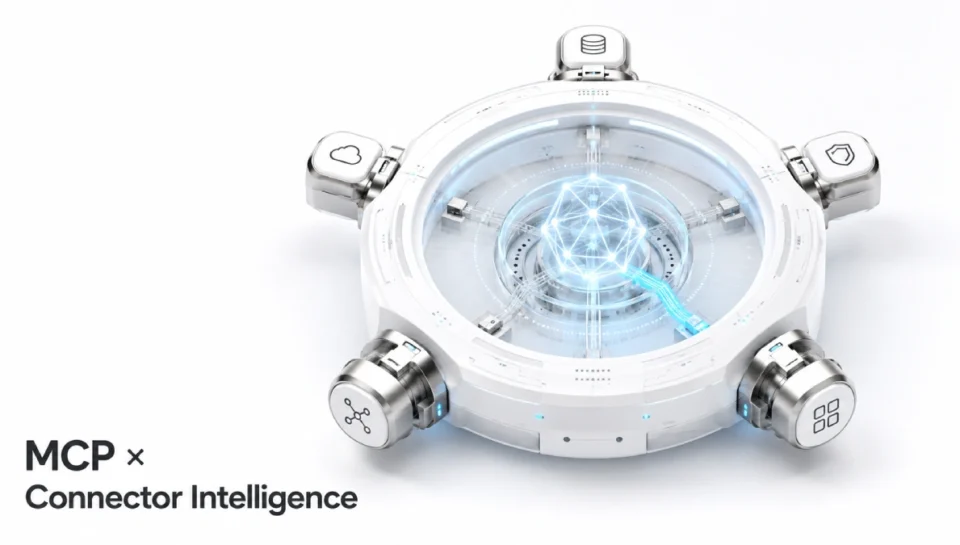

Connectors used to be boring in the best possible way.
They moved data from one system to another, blindly followed a known schema, and served workflows that behave predictably every time.
Now, AI agents have entered the chat.
The connections are no longer serving something that simply follows defined predefined instructions. It may be serving an agent deciding which tools to use, what actions to take, and how to interact with the systems behind it.
This blog looks at how MCP changes that, what it means for connector intelligence, and why agent-readiness is becoming part of the integration conversation.
MCP adds a new customer to the connector ecosystem
The Model Context Protocol (MCP), was originally open-sourced by Anthropic and now governed as a cross-vendor open standard. It gives AI agents a consistent way to reach external tools and data.
These are often the same systems connectors already work with. The difference is that an AI Agent, not a fixed workflow, is now using them.
In just one year, MCP has grown from early experiments towards a broader infrastructure layer with a growing number of servers.
For anyone working in the connector ecosystem, this changes what a connector needs to be.
Traditional Connectors and MCP Servers Share the Same Foundation
A traditional connector and an MCP server both share the same system’s capabilities to an outside customer. Both have to deal with authentication, schema, rate limits, upstream API changes and ongoing maintenance.
The only different factor is customers.
A traditional workflow calls the connector in a predefined approach every time.
Whereas an AI Agent decides based on natural language intent which tool to invoke and how.
Agent-Facing Interfaces Need More Than a Working Connection
A traditional workflow already knows the “right” sequence. An Agent facing interface cannot assume the caller does.
That puts more weight on:
- Tools descriptions,
- Scoping,
- Guardrails,
- Clear access boundaries.
But underneath that, the connector problem remains the same: coverage, quality and maintenance.
MCP comes for alignment, not as a replacement.
The work behind Connector Intelligence: tracking, benchmarking and surfacing insights across the integration ecosystem, expands to include another layer.
It is no longer only: which platform does this product integrate with, and how well?
It also becomes: which of those integrations are agent-consumable, and how are they exposed?
The Questions Security Buyers and Vendors Now Need to Ask
The following questions are the top ones that both vendors and buyers are asking and why:
- Does the product integrate with our stack?
This remains a core buying question. Coverage still matters, and products need reliable integrations across the systems customers already use.
- Can our agent use those integrations?
A product can have a rich traditional connector catalog and still lack an agent-facing interface. As agentic workflows enter operations, that creates another dimension of connector debt.
- Is an agent-facing interface simply an extension of an existing connector?
No. It introduces its own requirements around tool descriptions, scoping, guardrails, permissions, observability, and ongoing maintenance.
- What does this mean for younger security vendors?
For vendors with lean teams and smaller catalogs, agent-readiness becomes a roadmap decision. Building and maintaining these interfaces requires its own resources and upkeep.
Coverage alone is no longer enough
This is where connector strategy becomes a security issue.
A traditional connector that is misconfigured may create operational problems such as:
- Broken data flow,
- Failed synchronization,
- Interrupted downstream processes.
An MCP server can sit in a more sensitive position because it exposes tools and resources that an AI agent can use to access downstream systems such as:
- SaaS applications,
- Databases,
- Internal services,
- Security tooling.
That makes it a live attack surface, not just a coverage checkbox.
The Risk often comes from Implementation and Governance
The risks that have surfaced around MCP are, for the most part, implementation and governance failures rather than protocol flaws. They include:
- Over-board permissions: An agent receives more access than the task requires.
- Compromised servers: A malicious or compromised server enters the supply chain like a bad dependency.
- Data exfiltration: Information reaches endpoints that were never authorized.
- Weak audit trails: Teams cannot reliably reconstruct what an agent did with the access it held.
Once agents can act through integrations, knowing that a capability exists is no longer enough.
The more useful signal is how that capability is exposed.
Connector Intelligence has to become trust intelligence
In an agentic environment, connector intelligence has to account for more than availability.
Teams need visibility into:
- What the integration is scoped to reach,
- Whether its permissions match its purpose,
- Whether its behaviour is observable,
- Whether it can be trusted while brokering agent access to real systems.
That creates both a benchmarking problem and a security engineering problem.
It is also where ForshTec’s experts can contribute.
What MCP Changes for Security Vendors?
The connector ecosystem is not being replaced by an agentic one. It is absorbing it. The three qualities that have traditionally defined a strong integration still matter:
- Coverage,
- Quality,
- Maintainability.
MCP adds a fourth: trustworthiness under agent control. For vendors, that creates three practical priorities:
1. Treat Agent-Readiness as a Roadmap Decision
An agent-facing interface should not become an afterthought added only when a deal requires it.
2. Treat Exposure as a Security Decision
Scope, permissions, and observability determine whether an interface is useful or becomes a liability.
3. Evaluate Coverage and Trust Together
“Do you integrate?” and “Can we trust that integration in the hands of an agent?” are becoming part of the same evaluation.
Where Connector Intelligence Goes Next
Connector Intelligence has always helped make the connector ecosystem easier to understand: where coverage is strong, where gaps exist, and where things are moving.
Now there is another layer to map: agent-facing integrations.
It is no longer enough to know what connects to what. Teams also need to understand how safely those connections can be used when an agent is involved.
That brings two things onto the same map: coverage and trust.
ForshTec builds and maintains security integrations and helps vendors, ISVs, and MSSPs understand the connector ecosystem through Connector Intelligence. As agent-facing interfaces become part of that ecosystem, we are looking at both what connects and how safely those connections can be used. If agent-readiness is becoming part of your roadmap, we are glad to talk it through.