

If you are a CISO, IT Director, or security leader, you have likely sat in a budget meeting recently trying to answer an uncomfortable question: “Do we really need to build our own Security Operations Center (SOC), or should we just outsource it?”
It is a high-stakes decision. The threat landscape has grown incredibly fast and automated. The average attacker breakout time, or the window it takes a threat actor to move laterally across your systems after initial access has plummeted to just under 30 minutes. If your detection systems can’t catch an intrusion instantly, the game is over before your team even receives the alert.
Simultaneously, the global cybersecurity talent shortage sits at a staggering 4.8 million unfilled positions. Finding, hiring, and retaining the specialized engineering talent required to operate a traditional Security Information and Event Management (SIEM) platform is harder and more expensive than ever.
Choosing between an In-House SIEM and a Managed SIEM isn’t just about comparing software features. It is a fundamental operational decision that impacts your budget, your compliance posture, and your team’s sanity.
This guide breaks down the cold operational realities, costs, and strategic trade-offs of both approaches alongside the hybrid model bridging the gap.
The Core Technical Difference
Before diving into finances, let’s establish what we are actually comparing.
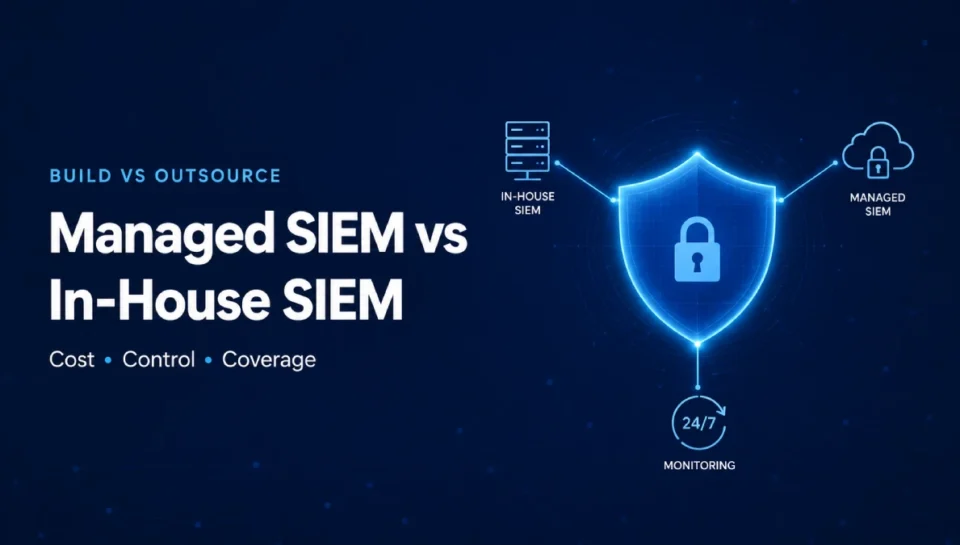
- In-House SIEM: Your organization purchases a SIEM platform (e.g., Splunk, Microsoft Sentinel, Elastic Security). Your internal security engineering team builds the architecture, configures log ingestion, writes detection rules, tunes out the noise, and mans a 24/7/365 SOC to triage alerts.
- Managed SIEM: You outsource the operational burden to a Managed Security Service Provider (MSSP) or a Managed Detection and Response (MDR) vendor. They collect your logs, process them in their own platform (or a dedicated instance), monitor them around the clock, and send your IT team curated alerts when something goes wrong.
1. In-House SIEM: Complete Control at Premium Cost
Deploying an in-house SIEM is the equivalent of building your own custom-built security fortress. You own every brick, but you also have to sweep the floors and fix the plumbing.
The Pros of In-House SIEM
- Absolute Data Sovereignty: For organizations in highly regulated sectors like defense (CMMC), healthcare (HIPAA), or banking, sending raw telemetry to a third party introduces compliance headaches. Keeping your SIEM in-house ensures you retain 100% ownership and control over where your data resides.
- Granular Customization & Rule Tuning: An external provider will never understand your network topography like your own team. With an in-house SIEM, you can write hyper-specific detection engineering rules for proprietary, legacy, or homegrown applications that an off-the-shelf vendor would completely miss.
- Deep Contextual Incident Response: When an alert fires, an internal team instantly knows if “User X” accessing a database at 2:00 AM is a critical breach or just the Lead Dev deploying a scheduled update. This internal tribal knowledge dramatically reduces incident resolution times.
The Cons of In-House SIEM
- The “Alert Fatigue” Talent Drain: SIEMs are notoriously noisy. Without massive, ongoing engineering effort, they generate thousands of false positives daily. If your few security hires spend their entire day clearing junk alerts from domain controllers, they will burn out and quit.
- Extreme Overhead: To run a true 24/7/365 security operation in-house, you cannot just hire one or two analysts. Accounting for weekends, holidays, sickness, and shift rotations, it takes a minimum floor of 5 to 8 full-time employees (FTEs) just to keep eyes on screens at all times.
- Extended Time-to-Value: Traditional enterprise SIEM deployments routinely take anywhere from six months to a year to properly configure, onboard data sources, and tune to a functional steady state.
2. Managed SIEM: Rapid Deployment with Operational Limits
Managed SIEM shifts the complex infrastructure and the 24/7 human triage burden to an external provider.
The Pros of Managed SIEM
- Instant 24/7/365 Coverage: The moment your log pipelines connect to a managed provider, you instantly tap into a fully functional, fully staffed SOC. Your internal IT staff can sleep soundly knowing someone is watching the gates on Christmas Eve.
- Predictable Operational Spending: Instead of paying for unforeseen hardware scaling, compute spikes, and recruitment costs, managed SIEM providers typically charge a predictable monthly or annual subscription fee.
- Crowdsourced Threat Intelligence: Managed security providers monitor hundreds of companies simultaneously. If they detect a novel ransomware strain or a zero-day exploit hitting a client in the financial sector, they immediately deploy protective detection rules across their entire customer base.
The Cons of Managed SIEM
- The “Black Box” Dilemma: Many pure-play managed providers give you very little visibility into what happens behind the scenes. You receive a ticket stating “Malicious traffic detected on Host Y,” but you are often left blind without access to the raw telemetry or the underlying correlation logic to see how they reached that conclusion.
- The Customization Ceiling: Managed SIEM vendors rely on standardization to remain profitable. If your organization runs custom, non-standard business systems, the vendor may refuse to build parsers for them, or they will charge exorbitant professional service fees to do so.
- Integration and API Friction: Your security visibility is only as good as the logs your vendor accepts. If you adopt a new cloud application or SaaS tool that the vendor’s platform doesn’t natively support via API, you are left with a massive security blind spot.
3. The Cold Financial Reality: A TCO Comparison
A common mistake is looking solely at software licensing fees when evaluating an in-house SIEM. The license is actually the smallest part of the bill.
According to 2026 data tracking enterprise deployments, the Total Cost of Ownership (TCO) break-down consistently reveals that human staffing and hidden operational costs make up roughly 60% to 80% of an in-house SIEM budget.
Let’s look at a typical annual cost projection for a mid-market enterprise (roughly 100 to 1,000 employees ingesting 50 to 100 GB of log data per day):
| Cost Element | In-House SIEM (Build) | Managed SIEM (Outsource) |
|---|---|---|
| Software/Vendor Fees | $50,000 – $150,000+ (Splunk, Sentinel, etc.) | $60,000 – $180,000 (All-inclusive subscription) |
| Data Storage & Retention | $10,000 – $40,000+ (Hot/Warm cloud storage tiers) | Included in tier (usually covers 90 days to 1 year) |
| Staffing & Recruitment | $400,000 – $800,000+ (Minimum 3-5 analysts + 1 engineer) | $0 (Handled entirely by the provider) |
| Initial Deployment / Tuning | $30,000+ (Professional services/consultants) | Included or minimal onboarding fee |
| Estimated Annual TCO | $490,000 – $1,020,000+ | $60,000 – $180,000 |
The Staffing Math: The median salary for a single specialized SIEM Engineer or SOC Analyst in the U.S. sits well above $120,000 per year. When you add benefits, taxes, tools, and management overhead, a single headcount easily costs an organization $160,000+ fully loaded.
4. The Hybrid Model: The Co-Managed SIEM
Because the financial and operational gap between 100% in-house and 100% outsourced is massive, the market has heavily shifted toward a middle path: Co-Managed (Hybrid) SIEM.
In a co-managed architecture, you license a modern, cloud-native platform (such as Microsoft Sentinel or Elastic) that stays completely within your environment. You then hire a managed detection partner (an MDR provider) who hooks into your console via APIs or federated access.
How the Work is Shared:
- The Vendor’s Job: They handle the relentless, crushing flow of Tier 1 alerts at 2:00 AM. They filter out the white noise, block low-level brute-force attempts automatically, and escalate only verified, severe incidents.
- Your Team’s Job: Your internal engineers retain full access to the dashboard. They focus on internal business logic, design custom rules for internal apps, and take charge of high-value incident response when the vendor escalates a true threat.
This model limits the risk of the “black box” while avoiding the million-dollar cost of staffing a 24/7 watch rotation yourself.
Decision Framework: Which Strategy Fits Your Business?
To choose the optimal path for your organization, review this direct diagnostic checklist:
Choose In-House SIEM if:
- You operate in a hyper-regulated framework (Defense, National Security, Infrastructure) that explicitly prohibits third-party data access.
- You already have a mature IT/Security team of 6+ professionals and have the budget to scale further.
- Your network is highly irregular, relying heavily on custom proprietary software that requires bespoke detection engineering.
Choose Managed SIEM if:
- You have an internal security team of fewer than 3 people who are currently wearing multiple operational hats.
- You need to achieve strict compliance requirements (such as passing a SOC 2 audit or securing cyber insurance) within a matter of weeks, not months.
- Your infrastructure is heavily built on standard, cloud-native SaaS environments (Microsoft 365, AWS, Google Workspace) that map perfectly to standard vendor rule sets.
Choose Co-Managed (Hybrid) SIEM if:
- You want to retain complete ownership of your security data logs but refuse to run an expensive night-and-weekend graveyard shift rotation.
- You want the ultimate capability to audit your managed provider’s triage work to guarantee they are actually hitting their SLAs.
ForshTec Managed SIEM & MDR
If you need the rigorous, round-the-clock protection of an enterprise-grade SOC without the crushing overhead of building it yourself, ForshTec bridges the gap.
ForshTec delivers a highly transparent, deeply integrated Managed SIEM and MDR solution tailored to your risk profile. We act as an extension of your team, providing 24/7 continuous monitoring, proactive threat hunting, and full visibility so you can stay secure and compliant without the million-dollar price tag.
Ready to stop chasing alerts and start managing risk?
Schedule a technical deep-dive with a ForshTec security architect today.